




Artificial Intelligence in the AEC Industry: How We Are Preparing for the Future
07.05.2026
The challenge is ensuring technology doesn’t dictate the outcome, but is guided by a creative vision
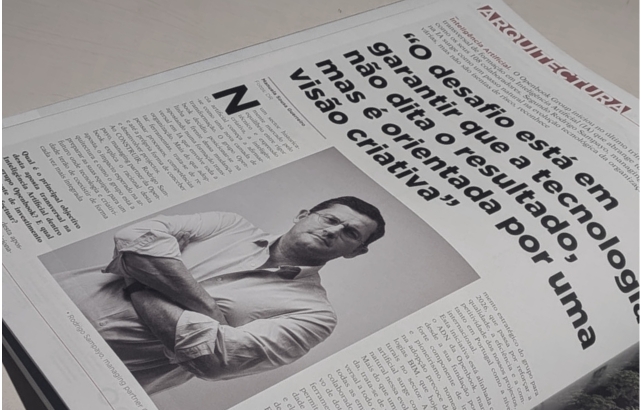
In the final quarter of 2025, we launched a cross-company artificial intelligence training programme covering the entire group and its 108 collaborators. The initiative quickly attracted attention across the sector, and in April 2026 Construir magazine published an interview with Rodrigo Sampayo, managing partner of Openbook, exploring the rationale behind this commitment, the expected impact on the AEC industry, and how we think about the relationship between creativity and technology.
Interview originally published in Construir magazine, April 2026.
CONSTRUIR: What is the main objective of this cross-company commitment to Artificial Intelligence within Openbook Group? And what level of investment are you making?
RODIGO SAMPAYO: The main objective fits within the group’s strategic positioning for 2026, which focuses on strengthening the quality, efficiency and competitiveness of our projects, both in Portugal and internationally.
This initiative is aligned with Openbook’s DNA, shaped since our founding by a strong culture of innovation and pioneering spirit, particularly through our early adoption of BIM methodologies, which are now structural to the industry. Artificial intelligence is a natural next step in that evolution.
More than an isolated initiative, this is a group-wide commitment involving all companies and their 108 collaborators, with the aim of equipping every professional with the tools and skills to increase productivity, reduce repetitive tasks and raise the quality of the work we deliver. This represents a significant investment for the group, including a structured training programme for all collaborators, as well as the progressive development of specific competencies and applications tailored to each area of expertise.
Is Artificial Intelligence seen more as an efficiency tool or as something that could change the business model? Do you think AI will change how architecture and engineering firms operate?
It is not yet fully visible in Portugal, but the AEC industry is going through a period of strong acceleration, driven by generative artificial intelligence models. In reality, artificial intelligence has been in use for several years, primarily through the various software platforms and digital tools that support different technical disciplines. At Openbook, this integration is particularly evident in how we bring multiple specialisms together under the same roof, especially in BIM workflows and in the way we present projects to clients.
In the first phase, AI will primarily be an efficiency tool, enabling us to optimise processes, reduce repetitive tasks and enhance the talent of our teams. Rather than replacing, it amplifies our capacity to respond and the quality of what we produce. At a second stage, it could have a more structural impact, allowing us to take on more complex projects, meet greater challenges and strengthen our presence in international markets. It is reasonable to expect that artificial intelligence will progressively transform how firms operate, both in terms of processes and in how projects are conceived, developed and delivered.
What skills do you believe will become most important for architects and engineers in the coming years?
At Openbook, we have always believed that creative freedom and genuine project involvement should sit at the heart of what we do. There is a significant technical and administrative dimension to our work, especially when dealing with public bodies, but our aim is for professionals to focus on what truly makes a difference. With the introduction of artificial intelligence, we are looking to ease some of that operational burden, freeing teams to spend more time developing creative and distinctive solutions.
In that context, we believe the most important competencies of the future will be strategic ones: critical thinking, creativity, conceptualisation and the ability to interpret information. It is that more human dimension, of closeness and deep understanding of clients, often going beyond the formal brief, that will continue to distinguish the quality of projects.
What is the hardest part of implementing AI in a company the size of Openbook: technology or people?
With a team of over 100 collaborators and a commitment to involving the whole organisation, we are facing a demanding process with a degree of complexity.
From a technical standpoint, there are real challenges: ensuring everyone has the right equipment and tools, and establishing robust data security and protection policies. Even so, the human factor is typically the most decisive. At Openbook, this transition has been positive. There is an internal culture shaped by curiosity and openness to change, which has made the adoption of these tools much smoother.
The partnership with NORDFY has also been fundamental. The quality of the training and the technical expertise of the trainers have helped not only in building the skills of our teams, but also in clarifying concepts and reducing the uncertainty that tends to accompany new technologies. Internal communication and continuous team engagement have been essential to maintaining alignment and commitment throughout the process.
Does integrating AI necessarily require a shift in work culture?
We believe that changes of this nature should not be imposed artificially, particularly in a context like architecture, where creative processes require time and consistency. Forcing that transformation could compromise the quality of our projects. So we are approaching this transition in a structured and progressive way.
We are aware that this change is already under way in the sector. Our role is to follow it consciously, staying at the forefront while maintaining rigour. Because even though we know we have a culture of innovation, we want to ensure that teams have the conditions to integrate all these tools into their daily work in a considered, deliberate and effective way, and ultimately in a way that is sustainable over the long term.
Which tasks do you think will disappear first in a firm like yours?
Change is fast and not always entirely predictable, but the first tasks to be automated will most likely be the most repetitive and administrative ones: producing documentation, organising information, supporting reports.
The objective is not to replace roles, but to free professionals from those tasks so they can focus on the more critical and creative dimensions of the work. It will always be essential to have qualified professionals overseeing these processes, ensuring rigour and quality.
In which project phases do you believe AI will have the greatest short-term impact?
In the short term, the greatest impact will be in technical documentation, project management and the coordination of specialisms. These are areas with large volumes of information and a constant need for coordination between different parties. AI can automate processes, support data validation and identify conflicts earlier. That capacity for anticipation will allow us to act with greater rigour and reduce rework, while freeing up time for the more critical and creative phases of a project.
Can AI enhance creativity, or is there a risk of homogenisation?
That will be one of the greatest challenges. We are already seeing the risk of homogenisation in some areas, with an impact on the originality of solutions. That is why the differentiating factor will continue to be human: critical thinking, creativity and sensitivity will be essential. There is a risk of taking the easy path, and it is precisely there that we need to be most demanding.
At Openbook, we reinforce that alongside artificial intelligence, natural intelligence will always exist. It is what gives projects intention, context and meaning. The combination of technology and creativity has the potential to raise the quality of solutions, provided there is direction and critical thinking.
How does a firm maintain its creative identity in an age of AI?
A firm’s creative identity depends on its people, their talent and their culture. It is sustained through a clear DNA, a shared culture and a consistent vision of what we want to deliver.
At the same time, it evolves with new tools and competencies. AI should be seen as an instrument in service of that evolution. The challenge is ensuring that technology does not dictate the outcome, but is guided by a creative vision. When that happens, identity is reinforced rather than diluted.
How do you imagine a firm operating in five years’ time? Will those who don’t use AI fall behind?
The fact that we are already investing in the training of our teams demonstrates that this is a strategic priority. There is still some perception of people being replaced, but we see AI as a tool that should be integrated consciously and progressively.
At the same time, it is clear that we are facing a structural shift. Integrating AI is not a hypothesis; it is an evolving reality. Organisations that do not follow this transformation risk losing competitiveness. In five years, we picture firms that are more efficient, more digitally integrated, with teams supported by intelligent systems. But it will always be the combination of technology and talent that makes the difference.
Inteligência Artificial na indústria AEC: como nos estamos a preparar para o futuro
O desafio está em garantir que a tecnologia não dita o resultado, mas é orientada por uma visão criativa.
No último trimestre de 2025, lançámos um programa transversal de formação em Inteligência Artificial que envolve todo o universo do grupo e os seus 108 colaboradores. A iniciativa rapidamente captou a atenção do sector, e em abril de 2026 a revista Construir publicou uma entrevista com Rodrigo Sampayo, managing partner da Openbook, onde explorou o racional desta aposta, o impacto esperado na indústria AEC e a forma como olhamos para a relação entre criatividade e tecnologia.
Entrevista originalmente publicada na revista Construir, abril de 2026.
Qual é o principal objectivo desta aposta transversal na Inteligência Artificial dentro do grupo Openbook? E qual o montante de investimento que estão a efectuar?
O principal objectivo desta aposta enquadra-se no posicionamento estratégico do grupo para 2026, que passa por reforçar a qualidade, a eficiência e a competitividade dos nossos projectos, tanto em Portugal como a nível internacional.
Esta iniciativa está alinhada com o ADN da Openbook, marcado desde a sua fundação por uma forte componente de inovação e pioneirismo, nomeadamente na adopção precoce de metodologias BIM, que hoje são estruturais no sector. A inteligência artificial surge como um passo natural nessa evolução.
Mais do que uma iniciativa isolada, trata-se de uma aposta transversal a todo o grupo, envolvendo todas as empresas e os seus 108 colaboradores, com o objectivo de dotar cada profissional de ferramentas e competências que permitam aumentar a produtividade, reduzir tarefas repetitivas e elevar a qualidade do trabalho desenvolvido. Este constitui um grande investimento do grupo, que inclui um programa estruturado de formação para todos os colaboradores, bem como o desenvolvimento progressivo de competências e aplicações específicas adaptadas a cada área de expertise.
A Inteligência Artificial é vista mais como ferramenta de eficiência ou como algo que pode mudar o modelo de negócio? Acha que a IA vai mudar a forma como os gabinetes de arquitectura e engenharia funcionam?
Ainda não é totalmente visível em Portugal, mas a indústria AEC está a atravessar um momento de forte aceleração, impulsionado pelos modelos de inteligência artificial generativa. Na realidade, a inteligência artificial já vinha sendo utilizada há vários anos, sobretudo através dos diferentes softwares e ferramentas digitais que suportam as diferentes áreas técnicas. No caso da Openbook, essa integração é particularmente evidente pela forma como reunimos várias valências no mesmo universo, sobretudo na integração em BIM ou na forma como são apresentados os projectos aos clientes.
Numa primeira fase, a IA será sobretudo uma ferramenta de eficiência, permitindo optimizar processos, reduzir tarefas repetitivas e potenciar o talento das equipas. Mais do que substituir, vem amplificar a capacidade de resposta e a qualidade do trabalho desenvolvido. Num segundo momento, poderá ter um impacto mais estrutural, permitindo abordar projectos mais complexos, responder a maiores desafios e reforçar a presença em mercados internacionais. É expectável que a inteligência artificial venha a transformar progressivamente a forma como os gabinetes operam, tanto ao nível dos processos como na forma como se pensa, desenvolve e entrega um projecto.
Que tipo de competências considera que se tornarão mais importantes nos próximos anos para arquitectos e engenheiros?
Na Openbook, sempre acreditámos que a liberdade criativa e o envolvimento nos projectos devem estar no centro do nosso trabalho. Existe uma componente técnica e administrativa relevante, especialmente no relacionamento com entidades públicas, mas o nosso objectivo é que os profissionais possam concentrar-se naquilo em que realmente fazem a diferença. Com a introdução da inteligência artificial, procuramos aliviar parte desse peso mais operacional, permitindo que as equipas tenham mais tempo para desenvolver soluções criativas e diferenciadoras.
Nesse contexto, acreditamos que as competências mais determinantes no futuro serão sobretudo as capacidades estratégicas: o pensamento crítico, a criatividade, a conceptualização e a capacidade de interpretar informação. Será essa dimensão mais humana, de proximidade e entendimento profundo dos clientes, muitas vezes para além do briefing formal, que continuará a diferenciar a qualidade dos projectos.
Qual é a parte mais difícil de implementar IA numa empresa com a dimensão da Openbook: tecnologia ou pessoas?
Com uma equipa de mais de 100 colaboradores e com o compromisso de envolver toda a organização, estamos perante um processo exigente e com algum grau de complexidade.
Do ponto de vista técnico, existem desafios relevantes, nomeadamente garantir que todos dispõem dos equipamentos e ferramentas adequadas, bem como assegurar políticas robustas de segurança e protecção de dados. Ainda assim, o factor humano é, tipicamente, o mais determinante. No caso da Openbook, essa transição tem sido positiva. Existe uma cultura interna marcada pela curiosidade e pela abertura à mudança, o que facilitou a adopção destas ferramentas.
A parceria com a NORDFY tem sido também fundamental. A qualidade da formação e o domínio técnico dos formadores têm ajudado não só na capacitação das equipas, mas também na clarificação de conceitos e na redução da incerteza associada a estas tecnologias. A comunicação interna e o envolvimento contínuo das equipas têm sido essenciais para garantir alinhamento e compromisso ao longo do processo.
Existe forçosamente uma mudança de cultura de trabalho para integrar IA?
Acreditamos que mudanças desta natureza não devem ser impostas de forma artificial, sobretudo num contexto como o da arquitectura, onde os processos criativos exigem tempo e consistência. Forçar essa transformação poderia comprometer a qualidade dos projectos. Por isso, estamos a encarar esta transição de forma estruturada e progressiva.
Estamos conscientes de que esta mudança já está em curso no sector. O nosso papel é acompanhá-la de forma consciente, mantendo-nos na linha da frente, mas com rigor. Porque apesar de sabermos que temos uma cultura de inovação, queremos garantir que as equipas tenham condições para integrar todas estas ferramentas no seu quotidiano de forma concertada, pensada e eficaz e, no fundo, sustentável a longo prazo.
Que tarefas acha que vão desaparecer primeiro num gabinete como o vosso?
A evolução é rápida e nem sempre totalmente previsível, mas é expectável que as primeiras tarefas a serem automatizadas sejam as mais repetitivas e administrativas: produção de documentação, organização de informação ou apoio a relatórios.
O objectivo não é substituir funções, mas libertar os profissionais dessas tarefas, permitindo que se concentrem nas dimensões mais críticas e criativas do trabalho. Continuará a ser essencial ter profissionais qualificados a acompanhar estes processos, garantindo rigor e qualidade.
Em que fases do processo de projecto acredita que a IA terá maior impacto a curto prazo?
A curto prazo, o maior impacto será ao nível da documentação técnica, da gestão de projecto e da coordenação de especialidades. São áreas com grande volume de informação e necessidade de articulação entre diferentes intervenientes. A IA poderá automatizar processos, apoiar a validação de dados e identificar conflitos de forma mais precoce. Essa capacidade de antecipação permitirá actuar com maior rigor e reduzir retrabalho, libertando tempo para as fases mais críticas e criativas do projecto.
A IA pode potenciar a criatividade ou existe o risco de uniformização?
Esse será um dos maiores desafios. Já se observa em algumas áreas o risco de uniformização, com impacto na originalidade das soluções. Por isso, o factor diferenciador continuará a ser humano. A capacidade crítica, a criatividade e a sensibilidade serão essenciais. Existe o risco de nos deixarmos levar pela facilidade, mas é precisamente aí que devemos ser mais exigentes.
Na Openbook, reforçamos que, a par da inteligência artificial, existirá sempre a inteligência natural. É essa que garante intenção, contexto e significado aos projectos. A combinação entre tecnologia e criatividade poderá elevar a qualidade das soluções, desde que exista direcção e pensamento crítico.
Como é que um gabinete mantém identidade criativa numa era de IA?
A identidade criativa de um gabinete depende das suas pessoas, do seu talento e da sua cultura. Mantém-se através de um ADN claro, de uma cultura partilhada e de uma visão consistente sobre o que se quer entregar.
Ao mesmo tempo, evolui com novas ferramentas e competências. A IA deve ser vista como um instrumento ao serviço dessa evolução. O desafio está em garantir que a tecnologia não dita o resultado, mas é orientada por uma visão criativa. Quando isso acontece, reforça-se a identidade em vez de a diluir.
Como imagina o funcionamento de um gabinete daqui a 5 anos? Quem não usar IA fica para trás?
O facto de estarmos já a investir na formação das nossas equipas demonstra que esta é uma prioridade estratégica. Existe ainda alguma percepção de substituição de pessoas, mas vemos a IA como uma ferramenta que deve ser integrada de forma consciente e progressiva.
Ao mesmo tempo, é evidente que estamos perante uma mudança estrutural. A integração da IA não é uma hipótese, é uma realidade em evolução. As organizações que não acompanharem esta transformação arriscam perder competitividade. Daqui a cinco anos, imaginamos gabinetes mais eficientes, mais integrados digitalmente e com equipas apoiadas por sistemas inteligentes. Mas será sempre a combinação entre tecnologia e talento que fará a diferença.